|
|
We would like to begin by thanking everyone for their winter sale orders - we are just in the process of dispatching the final ones now. |
With the sale wrapped up, we are excited to turn our attention to the Spring show season. We will be kicking things off at the Ulster BKA Conference on the 13th and 14th February in Northern Ireland, followed by The Beekeeping Show in Telford on Saturday 21st February. Orders can now be placed for collection at these events, as well as at all our upcoming shows. We will also be offering 15% off all Logar products when collected from any of the upcoming shows. This is an ideal opportunity to invest in their high-quality equipment. |
Keep an eye out for our new catalogue later this month, and don’t forget to add one to your basket with your order. |
Associations hosting beginners’ courses are welcome to contact us for a special discount code, plus catalogues and memory sticks. |
|
|
|
|
|
|
|
DSM stands for Dual Strong Multi, and that is exactly what this nuc is. The DSM Polynuc is strong and durable, compatible with 6 Langstroth or British Standard frames (frames not included). It can also be split to create two 3-frame nucs, both with individual entrances. Made from polystyrene with a density of 120 grams per litre, with reinforced plastic edging. |
|
|
|
|
- Reinforced plastic edging that allows hive tool to be used without damage.
- Solid division board allows the 6 frame nuc to become two 3 frame nucs.
- Removable top feeder that can be accessed from both sides.
- Ventilated floor that can be closed.
- Stackable with recesses for hive straps.
- Supplied in flat pack.
- Feeder can be accessed without removing the roof. |
| |
|
|
|
|
Buckfast Bees; Their Traits and Benefits |
Written by Russell Connor |
There is a short and longer version of this article. The short version provides the facts. The longer version provides the story of the development of the Buckfast bee which is inseparable from that of a man who, as a young German boy, was given up to the Benedictine monks and sent to Buckfast Abbey in Devon as part of a workforce to rebuild the monastery devastated four centuries before. The stories of the monastery, the monk and the honeybee are fascinating and intertwined. |
|
|
|
|
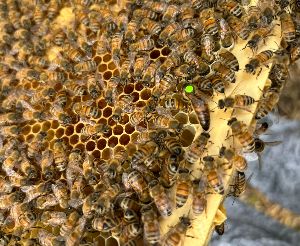
The Buckfast bee is not a pure subspecies of bee, it is a cross-breed of a number of sub-species and was first developed at Buckfast Abbey in Devon by Karl Kehrle OSB OBE, known as Brother Adam. |
The aims of the initial breeding process were to counter the devastating impact of the “Isle of Wight Disease” on the existing bee population and to produce a bee suitable for working the heather crop on Dartmoor. |
| |
|
|
|
The work of breeding the Buckfast bee continued at Buckfast led by Brother Adam until his retirement at the age of ninety-three in 1992. |
During Brother Adam’s lifetime, breeder queens were sent from the UK to breeders in other countries who reared offspring queens which were then marketed internationally. After Brother Adam’s death breeding of the Buckfast bee has continued by bee breeders, many of who belong to the European Federation of Buckfast Beekeepers’ Association. |
|
|
|
|
Given the long development of the Buckfast bee, the multiple crosses performed by Brother Adam and the wide geographic spread, the Buckfast bee can best be regarded as a trade-name for hybrid bees of varying ancestry that aim to replicate the behavioural characteristics sought by Brother Adam. |
The benefits of the Buckfast bee are directly linked to its traits or qualities. These qualities tend to produce colonies that are highly productive, docile and easy to manage. |
|
|
|
|
Buckfast breeder queens in the UK are generally sourced from German or Danish producers where the use of isolation apiaries has a long tradition or artificial insemination is practiced to high standards. |
|
|
|
|
|
|
| |
|
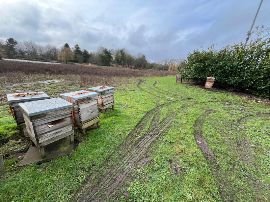
December and January have brought exactly the kind of weather you'd expect at this time of year – wet, grey, and with ground conditions that make every visit to the apiary a muddy affair. Here you can see the tracks we made just getting on and off the apiary! Despite the less-than-ideal conditions, we've been out checking our colonies and providing them with what they need to see them through the rest of winter. |
| |
|
|
|
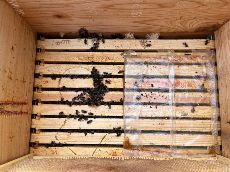
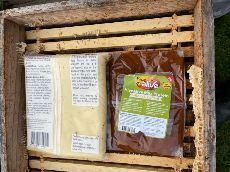
Over the past couple of months, we have noticed some variations between colonies. Some have worked their way through all the fondant we put on before Christmas, while others have not. The good news is that every single colony has taken the protein patties we put on, which suggests they're all in good condition and preparing for the spring build-up ahead. |
|
|
|
|
In January we've added more protein patties and fondant to make sure everyone has stores to get them through the rest of winter. We've also applied oxalic acid treatment to our colonies, using the ApiBioxal ready made liquid. This was really easy to use because it doesn’t need making up, warming up or any other special treatment. With little to no brood present at this time of year, it's the perfect opportunity to knock back any remaining varroa mites and give our bees the best possible start to the new season. |
| |
|
|
|
The strimming work we did earlier in the year has really paid off. The plants around the hives have died back nicely, leaving everything nice and flat. This makes winter access so much easier and will prevent the usual spring explosion of growth that can make it hard to inspect the bees efficiently. It's one of those jobs that's easy to put off, but we're grateful we made the effort when we did. |
When checking under the hives, there's not a huge amount of evidence of the bees having worked through their stores yet. The cappings and debris levels are relatively low, which isn't surprising given how cold it has been. Once the queens start laying and brood rearing picks up in the next few weeks, we expect this will change quite dramatically. It's a useful reminder for us to keep hefting hives regularly, even once the bees start foraging. Large colonies are often the ones to die out early in the season because they are usually the ones that will consume their stores very quickly. |
With treatments applied, feed in place and the apiary in good order (despite the weather), we're feeling pleased about how the bees are looking at this point in the year. As we head into February, we'll be keeping a close eye on stores and watching for those first signs of spring build-up. Before we know it, we'll be thinking about spring inspections! |
|
|
|
|
|
|
|
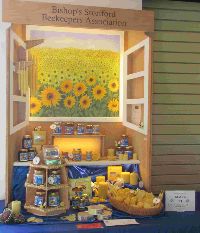
Following our amazing news, announced just after last year’s show, of the show’s volunteers being awarded The King’s Award for Voluntary Service (KAVS), as part of our celebrations at the 2026 show some of our classes will have a King’s Award theme. Decorative Class 31; a Decorative Design in Honeycomb built by bees Class 118; and the Decorated Honey Cake Class 181. And there’s nothing to stop you giving any other appropriate class a King’s Award theme. How about getting together with your association members to plan a shop window display? Previous entries have been not only amazing, but great fun to plan and put together. Now’s the time to start discovering more of the creative talent in your association. |
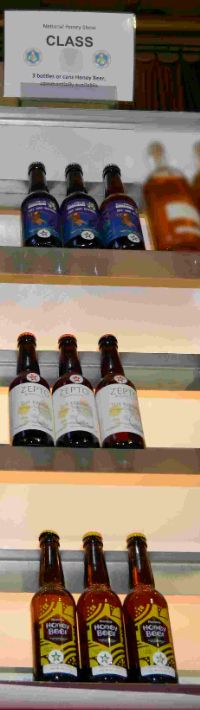
Are you a connoisseur of honey beer? You did know it’s commercially available? Did you, and your favourite honey beer brewery, also know there’s a class in the show for commercially available (Class 111) honey beer, as well as a class for non commercially available (Class 112) honey beer and for baggott (Class 113)? Confession: I had to look up ‘baggott’. It’s “a traditional, historic hybrid alcoholic beverage that blends beer (malted barley) and mead (honey), often with a 50/50 mix of fermentable sugars from malt and honey”. Sounds great! |
| |
Class 33: A Shop Window Display |
Class (now) 83: A Display of Beeswax, minimum six pieces |
|
|
|
|
Class (now) 111: Honey Beer, any style, 3 bottles or cans. The beer should be commercially available |
| |
For the last couple of years, we’ve had a chat with our wonderful sponsors, The Wax Chandlers, at the show. These have been presented on social media, live from the show. We have workshops and entry classes for wax modelling at the show, but it’s been fascinating to learn more about beeswax, the modern wax industry, its use in Harry Potter and other films, wax bricks, the melting wax house – all revealed in Angelina’s chat with Tony Ward and Lynda Marston-Weston at the 2025 show. |
We’ll have two lecture videos for release in February, Professor Stephen Martin’s “Understanding Varroa resistance” on Friday 6th; and Steve Riley’s “Transitioning from miticide treatments to Varroa-resistant honey” on Friday 20th. Stephen Martin and Steve Riley are part of a team working together, and you can view their conversation on selecting for Varroa resistant bees, presented live from the show https://www.youtube.com/watch?v=zcHEH9miwK8 |
We look forward to seeing you again in October, when we’ll have another great show for you.
National Honey Show Thursday 22nd to Saturday 24th October 2026 at Sandown Park Racecourse, Esher, Surrey, KT10 9RT, UK. |
|
|
|
|
|
|
|
The Beekeeping Show 2026, Saturday 21 February - Telford |
Bees for Development will be exhibiting at this year’s Beekeeping Show, the premier UK beekeeping trade show. The show runs from 9:30-16:00 at the Telford International Arena on Saturday 21 February, more details can be found at www.thebeekeepingshow.co.uk |
Pop along and say hello to the team! |
| |
|
|
| |
|
Jacob from Uganda with his woven hive ©BeesforDevelopment |
| |
Big Give Christmas Challenge 2025 |
Thank you to everyone who supported us and donated to our Big Give Christmas Challenge. Thanks to your generosity, we not only reached our target but were fortunate enough to exceed it something that simply wouldn’t have been possible without you. |
We are incredibly grateful to all our donors and especially delighted to welcome so many new supporters. Your kindness will allow us to develop disability-inclusive training for 300 beekeepers, men, women and young people in Uganda and Ghana. Thank you for being part of this achievement. |
|
|
|
|
Bees for Development Blog: Inspiring change in the younger generation through honeybees |
|
|
|
|
In rural Ghana, where subsistence agriculture and community life are deeply intertwined, Buzz Clubs have emerged as an innovative response to the environmental challenges posed by these livelihood activities. |
Our Buzz Clubs are designed to nurture knowledge, character, and responsibility among children to create environmental stewardship. Buzz Club Ghana began in 2016 with two schools in the Greater Accra and Bono East Regions. Today, with six recent clubs established in 2024, there are 16 clubs across four regions of Ghana. To read more, click HERE. |
| |
A sketch of honey bee with a bee attitude label ‘be joyful’ by a buzz clubber ©BeesforDevelopment |
|
|
|
| |
|
|
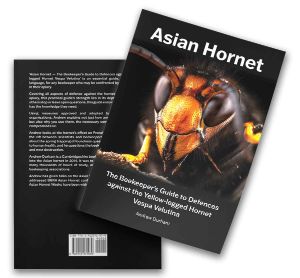
Asian Hornet: The beekeepers guide to defences against the yellow-legged hornet Vespa velutina
By Andrew Durham |
|
|
|
|
"The second edition of a book written by a Cambridgeshire Beekeeper who has for many years studied the yellow-legged Asian hornet in France. He emphasises that UK beekeepers need to be prepared NOW, rather than waiting until it is well established before worrying and panicking about it.. Highly recommended and good value.” – Norman Carreck NDB |
Northern Bee Books (1st ed. 2025)
Paperback
228 Pages
£26 |
Reviewed by Norman Carreck NDB, The Beekeepers Quarterly: September 2025 |
| |
|
|
|
This is the second edition of a book written by a Cambridgeshire Beekeeper who has for many years studied the yellow-legged Asian hornet in France, and worked with French beekeepers to find ways of living with the pest. |
The Introduction and background set the scene, emphasising that the hornet made little impact for the first few years after it arrived in France in 2004, but that hornet numbers rapidly rose thereafter, causing major problems. He emphasises that UK beekeepers need to be prepared NOW, rather than waiting until it is well established before worrying and panicking about it. He asks beekeepers to assess “What is likely to be the scale of the problem in my apiary”? and to act accordingly. |
He considers both the science and government. He suggests that some French scientists have performed valuable research for beekeepers, but others have simply regarded obtaining research funding as an end in itself and provided little information of lasting value. He feels the government was complacent, slow to act and incompetent, which led to a loss of confidence by beekeepers and hysteria among the general public. He criticises some scientists for placing too much reliance on desk-based modelling approaches, often based on flimsy field data and a lack of understanding of beekeeping, producing predictions that failed to be borne out in practice. However, this problem is not confined to France, and he criticises the 2024 paper from the UK Centre for Ecology and Hydrology which modelled data collected prior to the recent surge in UK hornet numbers to argue that control measures have been effective. |
Durham covers nest destruction, spring trapping and the risks to human health and to bee colonies. He then carefully discusses the pros and cons of numerous methods of protecting apiaries from hornets. These include various spring traps, but more importantly where you should place them, how to use them and how to interpret the results. Next, he discusses the various entrance devices designed to prevent entry by hornets while allowing bees to carry out their normal activities. The electric harp trap is discussed in detail, including their design, how best to site them, their usage, and how to assess their effectiveness. |
The book ends with an overview of what we know and how findings from France are relevant to the UK or other countries on the edge of the invasion front. There is a comprehensive and up to date list of references and further reading. Finally, there is a 26 page appendix with detailed instructions on how to make your own electric harp traps, which are currently available in the UK for about £300 each. |
The book is well illustrated with useful well reproduced photographs, and is written in a very practical, clear manner. Highly recommended and good value. |
|
|
|
|
|
|
| |
|
Tuesday, Thursday & Friday |
| |
|
|
| |
| |
|
|
|
| |
|
CAFRE, Greenmount Campus, Antrim, BT41 4PS |
|
|
|
| |
|
Telford International Centre, Telford, TF3 4JH |
|
|
|
| |
|
Royal Welsh Showground, Builth Wells, LD2 3SY |
|
|
|
| |
|
Harper Adams University, Shropshire, TF10 8NB |
|
|
|
| |
|
|
|